Augustus
Metamorphoses (Ovid Edition)Augustus stands at the culminating edge of the poem’s historical imagination: he is not presented through an extended personal episode, but as the living endpoint toward which Rome’s long sequence of wars, foundations, transformations, and apotheoses converges. His decisive significance lies in the conversion of imperial power into a divinely sanctioned order. The poem’s final movement places Augustus beside the gods, makes his authority universal, and treats his succession from Julius Caesar as the greatest proof of Caesar’s fame.
Identity and Historical Position
Augustus appears in the fifteenth book, whose announced subjects include Numa, the foundation of Crotone, the doctrines of Pythagoras, Hippolytus, Asclepius, Julius Caesar’s apotheosis, and the epilogue. This placement is itself meaningful. The poem has moved from the creation of the world and the transformations of gods and mortals toward Roman institutions, historical memory, and the future of imperial rule. Augustus belongs to that final historical register, where myth is no longer merely a record of supernatural change but a language for interpreting Rome’s destiny.
The immediate political background is the consolidation of Rome after earlier conflict. Mars puts on his polished helmet and addresses the heavenly throne while the Roman state is described as having grown and requiring sovereign guidance. The scene links military power to political succession: the armed god’s appearance frames the question of rule, while Augustus becomes the answer to the needs of the expanding state. His authority therefore emerges not as an isolated personal achievement but as the final form taken by Rome’s passage from instability toward empire.
Imperial Rule and Cosmic Order
The poem gives Augustus an earthly supremacy explicitly comparable to Jupiter’s rule of Heaven. Jupiter governs the heavens, while Augustus governs Earth; each receives the praise due both to a monarch and to a father. The comparison does more than flatter the emperor. It establishes a vertical political theology in which celestial sovereignty and Roman sovereignty mirror one another. Augustus’s power is represented as the terrestrial counterpart of divine government, so that imperial command appears to participate in the structure of the universe itself.
The reach attributed to Augustus is correspondingly universal. All the known Earth is to pay him homage, and the seas are to acknowledge his universal sway. This vision extends his rule beyond the immediate boundaries of Rome and turns conquest into a world-ordering force. Yet the same prophecy imagines a time when cruel war no longer disturbs humankind. Augustus is thus associated with both the power that expands Roman dominion and the peace that follows the exhaustion or resolution of conflict. His imperial image contains a deliberate progression from martial force to settled order.
The poem also presents his reign through the language of continuity and succession. The gods are urged to remember their care for Rome, and the emperor’s position is treated as the fulfillment of a larger providential history. The contrast with Saturn’s eclipse when Jupiter rose to power places Augustus within a recurring pattern of dynastic replacement: one sovereign age yields to another, and the new ruler inherits the authority of the old while reshaping its historical meaning.
Julius Caesar and Divine Descent
Augustus’s greatest fame is identified not simply with his own victories, but with his relationship to Julius Caesar. Caesar’s progeny is called his greatest distinction because the immortal son makes the father’s name endure. Augustus consequently functions as the continuation and confirmation of Caesar’s elevation. His existence transforms dynastic succession into a form of immortality: the father’s memory is preserved, enlarged, and politically realized through the son.
The poem takes care to prevent Augustus from seeming to arise from an ordinary mortal lineage. The beautiful goddess who bore Aeneas is invoked as the divine source behind Caesar’s ancestry, and the imperial line is thereby connected to Rome’s heroic and sacred origins. Augustus’s legitimacy is presented through a genealogy that reaches backward from contemporary rule to divine parentage, Trojan inheritance, and the foundation of Roman greatness. Political power is not merely inherited; it is mythologized as the visible expression of a bloodline already marked by the gods.
This ancestry also binds Augustus to the poem’s larger system of transformation. Bodies change into different forms throughout the work, and the closing books extend that principle into Roman history through the elevation of exceptional rulers into divine or stellar existence. Augustus is the political beneficiary of this logic even when his own transformation is not narrated as a separate metamorphic scene: Caesar becomes divine, and Augustus becomes the earthly heir who makes that divinity historically consequential.
The Imperial Future and Poetic Ending
The poem’s prophecy gives Augustus a future beyond ordinary human scale. His power is expected to spread as far as the two oceans, while foreign peoples and distant lands fall within the horizon of Roman homage. The sea-girt Britons are mentioned among those subdued by the courage associated with the imperial line. Such references enlarge Augustus from a Roman ruler into the center of a world map, making geography itself testify to imperial reach.
At the same time, the poem distinguishes Augustus’s lasting stature from the mortality of individual rulers. Caesar’s fleeting spirit, still fresh from his wounds, is to be carried away and changed into a star. In that transformation Julius Caesar receives divine rites, while Augustus receives the earthly sovereignty that makes Caesar’s posthumous honor meaningful. The two figures thus occupy complementary positions: Caesar becomes a celestial sign, and Augustus governs beneath it.
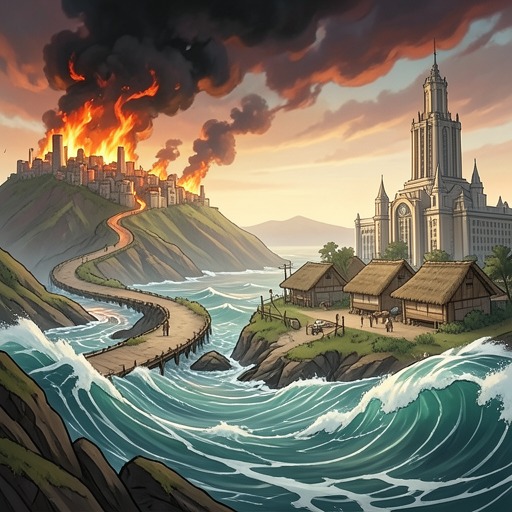
The final account of Augustus is inseparable from the poem’s own claim to endurance. The work is declared finished, yet it is said not to fear storms, fire, war, or wasting age. Augustus’s political fame and the poem’s poetic permanence are placed in parallel. Imperial power seeks to outlast local time through conquest and succession; poetry seeks to outlast destruction through form and memory. The closing vision therefore makes Augustus both the subject of praise and part of the mechanism by which the poem imagines its own survival.